Casino Night at Home: Snacks and Small Plates for a Games Evening
A casino night at home needs little more than cards, a few chips, and food that can be eaten with one hand. The look is borrowed from online venues such as Spinempire Casino, but the evening is made in the kitchen. Green felt and a roulette wheel set the mood for ten minutes; what guests remember afterwards is whether the snacks kept up with the games and whether anyone left hungry.
Food and card tables have a long shared history. The sandwich itself is said to take its name from an eighteenth-century English earl who, the story goes, asked for meat between two slices of bread so that a long session of cards would not have to stop for dinner. Whether or not the tale is accurate, it describes the brief perfectly: nothing that needs a knife and fork, nothing that leaves grease on the cards.
What makes a good card-table snack
Three tests are worth applying to anything on the menu. First, can it be picked up and finished in one or two bites? Second, does it leave fingers clean enough to handle cards and chips? Third, will it still taste good after forty minutes on the table? Dishes that pass all three tend to be simple: skewers, filled pastry cups, stuffed dates, cubes of firm cheese, roasted nuts, and vegetables cut to dipping size.
The usual party favourites fail more often than expected. Chicken wings in sticky sauce, loaded nachos, and anything dusted with orange cheese powder turn a deck of cards into a mess within a round or two. If those dishes are non-negotiable, serve them at a separate counter with plenty of napkins and keep the playing surface for drier food.
Building a grazing board
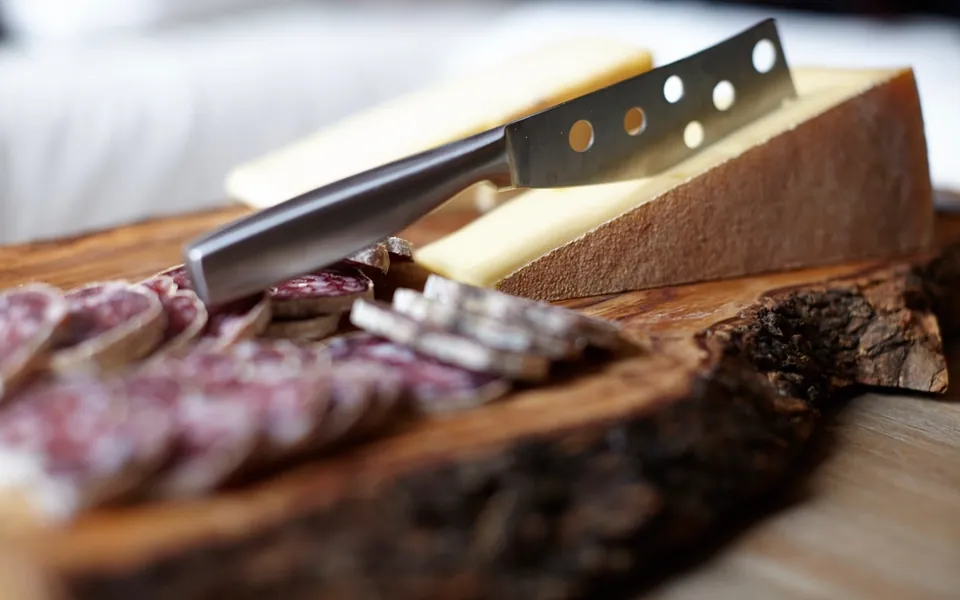
A board is the easiest centrepiece because it is assembled, not cooked. A workable formula for six to eight people is two or three cheeses of different textures, one or two cured meats, something crisp, something fresh, and something sweet. Aged cheddar from Quebec or Prince Edward Island, a soft goat cheese, and a wedge of something firm and nutty cover most tastes. Sliced salami or smoked turkey folds neatly onto crackers. Grapes, apple slices, and cucumber rounds add freshness, and a small bowl of maple-glazed walnuts handles the sweet end.
Cut everything before guests arrive. A block of cheese with a knife beside it looks generous, but it stalls the game every time someone stops to carve a piece. Pre-sliced cheese, pre-folded meat, and toothpicks keep things moving. For balance, Canada's Food Guide suggests filling half the plate with vegetables and fruit — a useful rule of thumb for a board as well, since a spread built only from cheese and charcuterie becomes heavy by the second hour.
Small plates that play on the theme
A few themed touches go a long way and none of them require special equipment:
- Red and black skewers — cherry tomatoes, black olives, and small mozzarella balls threaded in alternating colours.
- Suit-shaped sandwiches — thin tea sandwiches cut with heart, diamond, spade, and club cookie cutters; egg salad and cucumber with cream cheese both hold their shape.
- Dice cubes — watermelon and feta cut into even cubes and stacked in pairs on a pick.
- Chip stacks — rounds of cucumber, radish, and carrot layered with a dab of hummus.
- Lucky sevens — a seven-layer dip served in individual glasses with a spoon, so nobody double-dips over the table.
For something warm, puff-pastry pinwheels with spinach and cheese can be rolled and sliced in the afternoon, kept in the fridge, and baked in one batch just before the first hand is dealt. They are dry to the touch once cooled and reheat well.
Drinks and timing
Offer at least as many non-alcoholic options as alcoholic ones. Sparkling water with citrus slices, iced tea, and a pitcher of cranberry and ginger ale look festive in the same glasses as cocktails. Stemless glasses and short tumblers are harder to knock over than tall flutes, which matters on a crowded table.
Perishable food should not sit out indefinitely. The general food-safety advice is to return anything with meat, dairy, or eggs to the fridge within about two hours. The simplest way to manage that is to put out half of each dish at the start and swap in the chilled second half midway through the evening.
Keeping the games friendly
A home casino night works best when the stakes are symbolic. Play for chips with no cash value and award a small prize — a jar of homemade jam, a good chocolate bar — to whoever holds the most at the end. That keeps the focus on the company and the food, and it lets guests who do not gamble join in comfortably.
Real-money play is a separate matter. In Canada it is limited to adults: the minimum age is 19 in most provinces and 18 in Alberta, Manitoba, and Quebec. No game of chance offers a reliable way to make money, and outcomes cannot be predicted or influenced. For adults who choose to play, Canada's Lower-Risk Gambling Guidelines give three concrete limits: spend no more than one per cent of household income before tax per month, gamble on no more than four days per month, and avoid regularly playing more than two types of games. Setting a budget and a finishing time before starting is the practical version of the same advice.
A simple plan for the evening
Do the shopping two days ahead and the cutting on the morning of the party. Assemble the board an hour before guests arrive, cover it, and leave it somewhere cool. Bake the warm dish as the doorbell starts to ring. Set food on a side table within reach of the players, keep napkins in more than one place, and refresh the board once at the halfway point. With that much in hand, the host gets to sit down and play as well — which is the real measure of a well-planned games night.
← Back to Blog